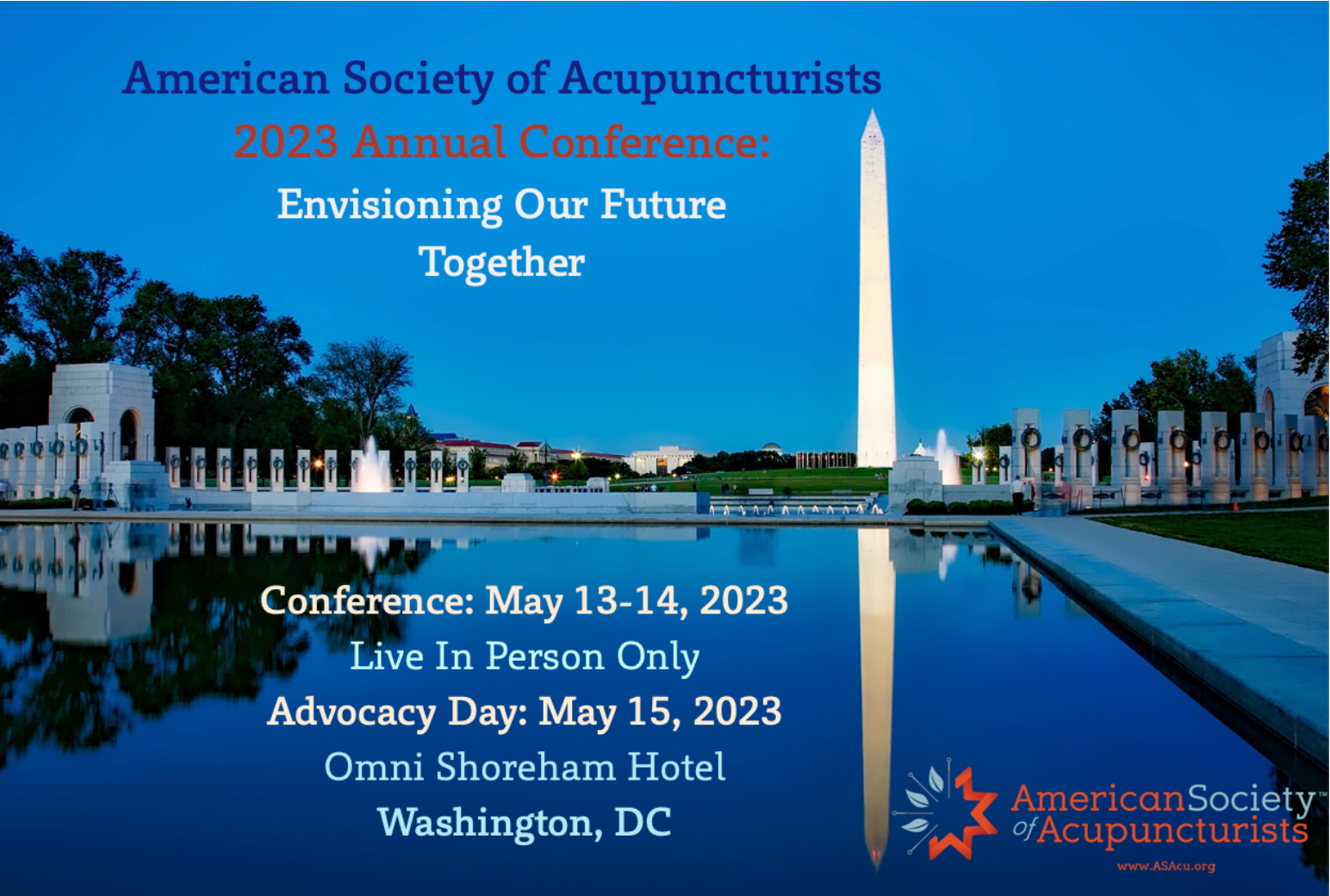
American Society of Acupuncturists
2023 Pre-Conference Webinar Series
Available: May 1 – 15, 2023
13 NCCAOM PDAs and CAB CEUs approved
for Pre-conference Webinar Series
California Acu Board (CAB), provider #1527

Pre-Conference Webinar Series
The American Society of Acupuncturists’ Pre-conference webinar series is designed to prepare your live-in-person conference experience in Washington DC. You will learn about issues such as orthopedic acupuncture, how to read a research paper, safe herbal compounding practices, and our Acupuncture Foundational Organizations. You will also learn about the hard work of the ASA’s Committees as our volunteers work to promote the acupuncture profession in the US.
Webinars will be available on demand from May 1, 2023 – May 15, 2023 (For CEU earning only).
Please note that ALL courses must be completed to receive credit. Partial credits are NOT given for this Bonus webinar series. You must complete this full series by May 15, 2023 (11:30pm EST) to receive 13 credits, along with the completion of the Worksheet and submission of the Quiz.
- While you are viewing the courses, you will be completing this Worksheet. Please go to “File” and “Make a Copy” for your files so that you can answer as you go along. This review worksheet is NOT graded but will be submitted/uploaded at the end with your Quiz.
- After you have viewed all the courses, you will take a Quiz. You must score a passing grade of 80% to obtain the 13 PDA/CEU credits for this webinar series. You will also upload your worksheet at the end of the Quiz.
This Webinar Series was brought to you by our Platinum, Gold, & Silver Sponsors:

COURSES:

1. The Shoulder Complex, Concepts and Strategies (Running Time: 60 mins 51 secs)
Stephen Cina, DAIH, MAOM, Lic. Ac., ATC, NASM CES
In this webinar, we will review common musculoskeletal imbalances of the shoulder and examine the biomechanical patterns that produce a host of pathologies in this area. Shoulder joint, girdle, and body mal-alignment are all contributing factors that produce pain and dysfunction of this region. After segmenting this area into its parts and applying a few functional assessments we can identify how to best focus our treatment. Traditional acupuncture techniques will be presented along with integrative orthopedic acupuncture approaches and exercise prescriptions. This video will provide the viewer with a starting point toward acupuncture integrative pain management.
Click to watch this webinar >>
2. Three Crucial Elements for a Successful Acupuncture Association
by leaders of ASA’s Governance Committee (GC), the Nominations Committee (NomCom) and the Strategic Planning Committee (SPC).
Part 1/2- Running Time: 36 mins 18 secs
Part 2/2 – Running Time: 20 mins 25 secs
David Bock, C.Ac., Dipl.OM. FABORM
Candace Sarges, MAc, LAc, DiplOM (NCCAOM)
Kelly Hora, MAc, LicAc, DiplAc (NCCAOM)


The ASA was founded to lead the Acupuncture profession on a national level, pulling together the state associations together into one powerful voice. There are three key committees within the ASA whose job it is to be the behind the scenes mechanics of the ASA. They are the Governance Committee (GC), the Nominations Committee (NomCom) and the Strategic Planning Committee (SPC). These three function essentially to maintain the past, present and future of this federation.
Participants will be introduced to basic principles of governance for acupuncture associations by GC and given examples and templates they can use. Sustainable leadership and growth are essential, NomCom will share how the ASA implements these processes for successful recruitment of leaders and cultivate membership through succession planning to avoid burnout. SPG, the “think tank,” for current and possible future issues will share how foresight and a big picture perspective of the profession at large can help plan for the future needs of the ASA and the profession.
It is everyone’s responsibility to engage in either your State Association or the ASA Committees or the ASA Board to ensure our position in the healthcare profession, protect our profession, our practice rights, and have our voices heard. That is only done with a strong collaboration between the state and national Boards and the engagement of all acupuncturists.
Click to watch part 1 of 2 of this webinar >>
Click to watch part 2 of 2 of this webinar >>

 3. Acupuncture Health Equity (Running Time: 55 mins 39 secs )
Afua Bromley, DACM, LAc, Dipl.Ac (NCCAOM) & LiMing Tseng, LicAc, MAcOM, Dipl OM (NCCAOM)
IDEA (Inclusive Diversity, Equity, and Access) are vital to increasing acupuncture’s role in healthcare.
To understand IDEA, we must understand the social determinants of health that impact systemic health inequities are produced by a complex array of circumstances that result in poor health outcomes and quality of life. These current and historical injustices affect all aspects of the acupuncture profession. We will examine how chronic low back pain, the current condition approved by Medicare for acupuncture coverage, can be affected by these social determinants of health.
Cultural humility is the lifelong learning process of self-evaluation, self-reflection, and self-assessment, with regard to one’s own identity and beliefs relative to others’ beliefs and cultural identities, while taking into account historical context.
This webinar will enable participants to identify issues unique to their own situation and examine their current and future patient population, to begin understanding their role within this process to create greater inclusive diversity, equity, and access to acupuncture.
Click to watch this webinar >>
4. American Society of Acupuncturists’ Pre-Conference Advocacy Training
(Running Time: 60 mins 09 secs )
Molly Ford, MPP, Director, Advocacy & Government Relations, NCCAOM
Jennifer Broadwell, AP, Dipl OM (NCCAOM)
Nell Smircina, DAOM, LicAc, Dipl OM (NCCAOM)


In preparation for the ASA Hill Day, this 60-minute Pre-Conference Training Webinar will provide Hill Day participants with an overview of the meaning of Medicare recognition and the ASA’s/NCCAOM’s effort to obtain this recognition for acupuncturists. We will review the federal legislative process and the makeup of the 118th Congress and The Acupuncture for our Seniors Act. Participants will learn the methods to effectively advocate for the Acupuncture for our Seniors Act during Hill meetings, as well as steps to take to prepare for upcoming Hill meetings.
The webinar will include a Q&A session. This webinar is mandatory for all ASA Hill Day participants.
Click to watch this webinar >>

 5. How the world can affect the practice of the Traditional Chinese Herbal Medical Practitioner (TCHM). (Running Time: 20 mins 35 secs)
Linda Robinson-Hidas, DACM, LicAc, Dip OM (NCCAOM) &
Amy Mager DACM, Lic.Ac., FABORM, Dipl OM (NCCAOM)
In this webinar, participants will learn about The Federal Trade Commission’s Health Products Compliance Guidance, and we will provide an overview of the rules regulating advertising.
An introduction of The ASA Herbal Medicine Committee’s documents for distribution and dissemination; “About Herbs,” an informational publication for laypersons & “What Medical Professionals Need To Know,” a one page informational publication for medical professionals will be shared. Finally, we will discuss with herbal purveyors and growers how politics, weather, sustainability, and the pandemic are influencing the availability and cost of herbal products.
Click to watch this webinar >>
“Additional Information from Industry Experts”
- Click to watch the video on Federal Trade Commission (FTC) Health Products Compliance Guidance by the ASA’s HerbMedComm >>
The Federal Trade Commission (FTC) has issued a new guidance document about advertising herbal products and dietary supplements. This is a review of the material contained in the document. It is important to be careful not to make health claims, either directly or implied without acceptable scientific evidence.(Running Time: 13 min 6 secs ) View PPT >>About Herbal Medicine Presentation – The Herbal Medicine Committee has been diligently working on these two documents. One document is for lay people and the other is designed for Medical professionals. They are almost complete and will soon be available for you to use in your practice. View PPT >>
- Click to watch the interview with Nuherbs / APHA (Wilson Lau) >> (Running Time: 10 mins 44 secs )
- Click to watch the interview with TCMZone (Dan Wen & Jennifer Knapp) >> (Running Time: 12 mins 40 secs )
- Click to watch the interview with KPC Herbs (Rosemary Tsai) >> (Running Time: 7 mins 55 secs )
- Click to watch the interview with Golden Flower Chinese Herbs (John Scott) >> (Running Time: 12 mins 17 secs )
 6. Overview of Fraud and Abuse Prohibitions (Running Time: 54 mins 44 secs)
John Murdoch, Esq
As most acupuncturists serve patients as independent practitioners in private or group clinics, we must all be aware of the issues related to business fraud and abuse and fraud prohibitions, so that we can avoid these mistakes.
In this class, we will discuss the corporate practice of the medicine doctrine and the business entities for acupuncturists. We will learn about the prohibitions against kickbacks, fee-splitting, and illegal self referrals. The fundamentals of insurance fraud and ways to establish compliance policies and procedures will be shared.
Click to watch this webinar >>
 7.Optimal Management and Clinical Experience Sharing of TCM for Irritable Bowel Syndrome (IBS)
(Running Time: 130 mins 41 secs)
Dr. Suiping Huang, MD, Ph.D
Irritable Bowel Syndrome (IBS) is a common digestive tract disorder, and its pathogenesis has not been fully elucidated by modern medicine. In recent years, the incidence of the disease has been increasing on a global scale. This lecture will present the clinical curative effect of TCM syndrome differentiation and treatment for IBS. Participants will be able to apply the techniques and knowledge gained through this course to their own practices.
Click to watch this webinar >>
8a. Acupuncture Research Committee: ASA Members Attitude Toward Research Survey Results (Running Time: 29 min 20 secs)
Lisa Ann Conboy, MA, MS, ScD
8b. Interlude – ASA Membership/Benefits Committee Report (Running Time: 7 min 5 secs)
Grace S. Ouchida, DACM, Dipl. OM (NCCAOM), LAc
8c. Tips on Reading Research Articles (Running Time: 74 mins 24 secs )
Lisa Ann Conboy, MA, MS, ScD
In October and November 2021 ASA surveyed its members querying on their research background, interests, and attitudes. The 28-item survey was administered on the SurveyMonkey® platform. Over 700 responses were received from ASA members. The ASA research committee is excited to share the results of this survey with our members. In this webinar we will review the quantitative and qualitative responses offered by members, with a focus on areas in which there was a range of responses or not clear agreement. We will also consider some of the broader implications for the profession and how application of our varied interests in research can help us thrive.
The tips on how to read a research article class will be focusing on biomedical science articles, the type of research that biomedicine considers to be most powerful. There are many scientific questions that can be asked and many ways of answering. Biomedical science, like any discipline, has a set of rules and terminology that is applied to support the most relevant type of information content for them.These rules lead to a certain format and control what type of information makes it into the article, and what types of information are left out. Because it is considered the highest form of evidence, this is the type of research we should know how to read so that we can be in conversations with legislators and allied health care providers. We hope the skills presented in this class help you to become more confident when you communicate about research and evidence.
Click to watch the 8a webinar >>
Click to watch the 8b interlude >>
Click to watch the 8c webinar >>
 9. Medicaid and Acupuncture and Why it Matters (Running Time: 69 mins 40 secs)
Tuesday Wasserman, DACM, LAc
This talk will introduce the audience to current acupuncture coverage in the states as well as explore how states have been working to gain and expand acupuncture services.
We will dive into the legislative process with a focus on implementation strategy, hurdles, and future goals.
By the end of this course, participants will be familiar with Medicaid coverage of acupuncture services, pathways to gain coverage, and key concepts related to Medicaid and the United States healthcare system.
Click to watch this webinar >>
 10. National Regulations for Herbal or Supplement Practice: Herbal Dispensing and Compounding Guidelines
Amy J. Sear, A.P., Dipl. O.M. (NCCAOM)
There are national FDA regulations regarding methods & procedures that all professionals that recommend, prescribe, buy, sell, dispense, compound, or mix herbs, or supplements, must know and adhere to. They are known as ‘Herbal Dispensing and Compounding Guidelines’ (part of FDA “cGMP”), and this course gives simple straightforward explanations of the history, rationale, definitions, and main categories of the guidelines. It provides how they actually benefit your practice, as they are based on safety, but they also provide patient satisfaction and compliance.
Click to watch this webinar >>
Additional Resources:
- American Herbal Products Association Good Herbal Compounding and Dispensing Practices
- Additional Training with Amy Sear
- NCCAOM’s Chinese Herbal Compounding Safety Certificate
11. Forty Years of US Acupuncture Accreditation & Certification – 11a: Mark McKenzie, Ph.D (China), MSOM, L.Ac, Executive Director of ACAHM (Running Time: 26 mins 52 secs) – 11b: Thomas Kouo, DAOM, L.Ac, Dipl. OM, Vice President of CCAHM (Running Time: 15 mins 25 secs ) – 11c: Mina Larson, MS, MBA, CAE, CEO of NCCAOM (Running TIme: 21 mins)


Over forty years ago, the organizational structure of the acupuncture profession was started with the creation of ACAHM (formerly ACAOM, NACSCAOM), CCAHM (formerly CCAOM, NCASC), and the NCCAOM (formerly NCCA). Leaders from these founding organizations of the acupuncture profession in the United States will share important information about their groups’ roles in the US acupuncture profession. Participants will learn about accreditations and certifications, as we examine the past 40 years in our profession.
Click to watch the 11a webinar >>
Click to watch the 11b webinar >>
Click to watch the 11c webinar >>
 12. Three Techniques To a Successful Practice (Running Time: 81 mins 30 secs )
Jeffrey Grossman, EAMP
Video Correction: Jeffrey Grossman is a Membership Benefits Committee member, but not an ASA Board member.
How do you bring in a steady flow of new patients? In this class, participants will learn about how to bring in new patients, retention of patients, and reactivation of past patients. Patient communication is most important along with the core messages of problem, solution, and outcome. We will discuss the ways to keep patient flow with appreciation, events, email marketing, and social media. You will also learn about retention methods through proper patient communication, and ways to reactivate patients when a patients fall out of care.
Click to watch this webinar >>
BioSketches of Speakers
David Bock C.Ac.,Dipl.OM. FABORM., has been treating patients in a family practice style of medicine since 1999. He is Wisconsin State Certified Acupuncturist, Nationally board certified (NCCAOM) in Oriental Medicine, Acupuncture, Chinese Herbal medicine and Asian Bodywork Therapies. He is a Fellow of the American Board of Oriental Reproductive Medicine. He is a Former president of Wisconsin Society of Certified Acupuncturists (WISCA) and has held various positions in the ASA. Shihan David Bock is Godan level (5th degree black belt) instructor of Wadokai Aikido and has 30+ years of study in various martial arts, and meditative breathing and movement traditions
Jennifer Broadwell, MSOM, AP, Dipl OM (NCCAOM) is the Advocacy Chair of the ASA and a member of the ASA NCCAOM Medicare Task Force. She served on the Florida State Oriental Medicine Association Board of Directors as vice president, secretary, and board director from 2012 to 2018. She has her Master’s from the Acupuncture and Massage College. Jennifer is currently the acupuncturist at the Integrative Health Department of the University of Tennessee Cancer Institute.
Afua Bromley, DACM, LAc, Dipl.Ac (NCCAOM), is the Past Chair (2017-2020) & Board member(2014-2022) of the NCCAOM and Co-Chair of the NCCAOM & ASA Acupuncture Medicine Cultural Competency Task Force. In addition to her private practice in St Louis, Missouri, she is also the founder and executive director of Universal Holistic Healthcare Services, a 501c3 nonprofit that works towards increasing access to integrative medicine for underserved and under-resourced communities domestically and globally.
Stephen Cina DAIH, MAOM, Lic. Ac., ATC, NASM CES is the Chair of the ASA Student Leadership Committee. He specializes in integrating East Asian and allopathic medical approaches for the treatment of orthopedic conditions and pain disorders. He received his Doctor of Acupuncture and Integrative Medicine degree from the New England School of Acupuncture (NESA) at MCPHS University. Steve serves as a full-time faculty member of the NESA where he teaches courses in anatomy, orthopedic acupuncture, and doctoral level integrative pain management. He is a member of the MCPHS Center for Interprofessional Practice and Education (CIPE), Faculty advisor to the Interprofessional Healthcare Forum (IPHF), and Student Association of the New England School of Acupuncture (SANESA). His accomplishments include acupuncture researcher at Massachusetts General Hospital’s Athinoula Martino’s Center for Biomedical Imaging, contributing member of the Academic Consortium for Integrative Health/Academy of Integrative Health and Medicine, and a former team acupuncturist for the Boston Bruins and the New England Patriots.
Lisa Ann Conboy, MA, MS, ScD has 30 years of experience in health research and is published in the areas of women’s health, complementary and alternative medicine, qualitative research methodologies, and complexity science. She has taught research methodology to integrative health students for over 25 years. Lisa is a social epidemiologist and a sociologist with an interest in the associations between social factors and health. She is published in the areas of women’s health, complementary and alternative medicine, qualitative research methodology, placebo and health, and complexity science. She is an Instructor at Beth Israel Deaconess Medical Center, Harvard Medical School, and the Director of Academic Research at Maryland University of Integrative Health. Dr. Conboy is the chair of the Research Committee of the American Society of Acupuncturists, and has been a member of the Society for Acupuncture Research for over 20 years.
Molly Ford, MPP, is the Director of Advocacy & Government Relations for NCCAOM. She is a senior manager of government relations at SmithBucklin Corporation. Molly graduated from George Washington University with her Master’s in Health Policy Analysis in 2012. She obtained her bachelor’s degree in European history from Smith College in 2006.
Jeffrey Grossman, EAMP, graduated from the New England School of Acupuncture in 1997 and is the founder of Acupuncture Media Works and AcuPerfect Websites. Since 2002, he has been creating and sharing patient education materials, marketing tools, practice building materials and websites for the acupuncture profession. Jeffrey is an expert-authority on business and marketing strategies, and currently teaches the practice management class at Middleway Acupuncture Institute in Washington state. He is a member of the ASA Membership Benefits Committee.
Kelly Hora, MAc, LicAc, DiplAc (NCCAOM) is a Wisconsin and National Board Certified Acupuncturist practicing in Madison, WI for 20 years. Her collaborative instincts bring people together through professional development and public health outreach. She has served as President and Advocacy Chair of the Wisconsin Society of Acupuncturists (WISCA) and as a Delegate and Nominating Committee Chair to the American Society of Acupuncturists. She is an eager public speaker sharing evidence supporting acupuncture as an alternative to opioids for pain management with legislators, health care providers and the public. In addition to her clinic practice, engaging in healthcare policy as an advocate for patient safety and access to acupuncture is an ongoing commitment.
Dr. Suiping Huang, MD, Ph.D is a renowned TCM gastroenterologist. He obtained his medical degree from the Guangzhou University of TCM. He is the chief physician, professor, and doctoral supervisor at the Guangzhou University of TCM, as well as the director of Gastroenterology at the Guangdong Provincial Hospital of TCM.
Dr. Huang has presided over and participated in 2 national-level projects, 3 provincial and ministerial-level projects, and 7 department-level projects.
He has edited 3 books and published more than 30 academic papers including Specialized Diseases Specialist Traditional Chinese Medicine Syndrome History.
Thomas Kouo, DAOM, L.Ac, Dipl. OM serves as the Vice-President for the Council of Colleges for Acupuncture and Herbal Medicine (CCAHM). He currently serves as both Academic and Clinical Dean at The Eastern School of Acupuncture and Traditional Medicine (ESATM) in Bloomfield, NJ. Under his leadership, the Eastern School developed and implemented the first Master’s degree in Acupuncture in the state of New Jersey in 2016. He also serves as the current Chair of the CCAHM School Clinic Committee and is the immediate past chair for the council’s Herb Committee. He is a long-time accreditation site visitor for (ACAHM). Prior to arriving at ESATM, Thomas served at Virginia University of Integrative Medicine (VUIM) as the Academic Dean and Chair of the Herbology department. Prior to VUIM, Thomas worked at Pacific College of Health Sciences San Diego, where he was the chair of the Herbal Department and taught in both the Master’s and Doctoral programs while also serving as a Clinical Supervisor. A graduate of the Master’s and Doctoral programs at Pacific College, he founded and was the clinical director of Elemental Harmony Acupuncture in San Diego
Mina Larson, MS, MBA, CAE is Chief Executive Officer of the National Certification Commission for Acupuncture and Oriental Medicine. She has devoted the past 20 years to the NCCAOM overseeing various aspects of the organization, such as operations, development, regulatory affairs, advocacy, media relations, communications, and marketing in a variety of roles including CEO, Deputy Executive Director, and Director of Public, Professional, and Regulatory Affairs.
Previous to working for NCCAOM, Mina worked in the State of California Office of the Governor.
She holds dual Bachelors’ degrees in Journalism and Government from California State University, Sacramento, a Master of Science in Non-Profit Association Management from University of Maryland University College and an MBA from University of Maryland. She has taught various training workshops throughout the country on improving media relations, marketing and advocacy and authored numerous articles on association management topics such as ethics, advocacy, and public relations.
Amy Mager DACM, Lic.Ac., Dipl OM (NCCAOM), FABORM, is the former ASA Vice Chair of Public Policy, and a past president of the Acupuncture Society of Massachusetts. She received her Doctorate in Acupuncture and Chinese Herbal Medicine from the Pacific College of Health Sciences and a Master of Science program from the American College of Traditional Chinese Medicine. She studied with Miriam Lee, Master Herbalist Dr. Yat-Ki Lai, and apprenticed with Raven Lang. She continues to expand her knowledge through classes, including an advanced certificate program in Chinese Herbal Medicine and women’s health issues and gynecology, becoming a Fellow of the American Board of Oriental Reproductive Medicine. Amy practices in Northampton, MA.
Mark McKenzie, Ph.D (China), MSOM, L.Ac, is the Executive Director of the Accreditation Commission for Acupuncture and Herbal Medicine. Prior to his ten-year service on ACAHM, he was the Dean of the College of Acupuncture and Oriental Medicine at Northwestern Health Sciences University for ten years. Overlapping with his time as Dean, he was also a member of the Council of Colleges of Acupuncture and Oriental Medicine (CCAOM), including serving a year as its Vice-President and was active with the Acupuncture and Oriental Medicine Association of Minnesota serving as its President for three years. He has his Doctor or TCM Internal Medicine degree from the Tianjin University of Traditional Chinese Medicine, and his Master of Science in Acupuncture and Oriental Medicine from Northwestern Health Sciences University.
John Murdoch is a shareholder of the law firm of Zager Fuchs, PC where he focuses his practice on business transactions and regulatory compliance issues affecting both small general businesses as well as licensed health care professionals and facilities such as physicians, dentists, acupuncturists, physical therapists, chiropractors, surgery centers, hospitals, etc.
With respect to regulatory compliance issues, he assists licensed professionals, facilities, and businesses in complying with the myriad of applicable state and federal regulations, including without limitation to HIPAA. John has presented seminars on the basics of contract law, forming a business entity, reviewing lease agreements, franchise agreements, insurance fraud, healthcare fraud, HIPAA compliance, health care fraud, and abuse laws, liquor license laws, to various healthcare professionals, businesses, and community groups.
He currently serves as the Secretary to the New Jersey State Bar Association’s Business Law Section. He is also an emeritus director of the New Jersey State Bar Association’s Health Law Section.
Linda Robinson-Hidas, DACM, LicAc, Dip OM (NCCAOM) is currently the ASA chair of the Herbal Medicine Committee, as well as of the American Society of Massachusetts. She was on the board of the Acupuncture Society of Massachusetts for 6 years, serving as Vice President and then President. She was also the Massachusetts delegate to the ASA during this time. Her education includes a Doctorate in Chinese Medicine from Pacific College of Oriental Medicine and a Master in Chinese Medicine from the American College of Traditional Chinese Medicine. She earned her Bachelors with dual majors in Biology and psychology from Livingston College; Rutgers University. She also studied massage at Scherer’s Academy. Linda practices Acupuncture and Traditional Chinese Herbal Medicine in Amherst, MA.
Candace Sarges, MAc, LAc, DiplOM (NCCAOM) is an NCCAOM Board Certified (OM) Licensed Acupuncturist in both New Jersey and Massachusetts in practice for 24 years. She served for 10 years as president of the New Jersey Association of Acupuncture and Oriental Medicine ( now known as the New Jersey Acupuncture Society). She has served at the national level since 2008; Chair of the Council of State Associations from 2011-2013, and as Immediate Past Chair during the transition from CSA to the ASA (prior to the ASA formal incorporation – a founding member) and as Immediate Past Chair on the ASA Board from 2015 to 2020. She was Chair of the Nominating Committee from 2015 to 2019, and is currently Chair of the Strategic Planning Committee.
Amy J. Sear, A.P., Dipl. O.M. (NCCAOM) is an experienced speaker and is valued for her organized, practical, and information filled presentations. She served as President of FSOMA from 2004 to 2010, and currently teaches at two schools in Florida. She has taught Herbal Dispensary and Compounding Guidelines since 2010, and is considered an expert in this topic, along with laws, safety, ethics, integration and documentation. She brings her years of respected teaching experience to this topic in order to help others. She has numerous PDA and CEU courses available on this and an array of topics: www.sear-enity-seminars.com
Nell Smircina, DAOM, L.Ac., Dipl. OM (NCCAOM) is the ASA Vice Chair of Public Policy. She is the Immediate Past Chair of CSOMA and has served on both the Advocacy Committee and ASA NCCAOM Medicare Task Force. In addition to her state and national experience, she also is the Director of Development for the American Acupuncture Council, working to support the profession through many strategic initiatives, including work to further develop the implementation of ICD11 codes. She is a passionate international speaker on the topics of the integration of medicine and the constantly evolving healthcare industry.
LiMing Tseng, LicAc, MAcOM, Dipl OM (NCCAOM) is a co-chair of the NCCAOM ASA Acupuncture Medicine Cultural Competency Task. She is a former Board member and secretary of the American Society of Acupuncturists (ASA) (2015-2021), and the current Chair of the ASA Conference Committee. She is a graduate of the Diversity & Inclusion certificate program from Cornell University. Aside from her acupuncture volunteerism, she maintains a private acupuncture practice in Stowe, VT.
Tuesday Wasserman, DACM, LAc, is the Chair of the ASA Medicaid Committee. She serves as Program Director of the doctoral completion program at Pacific College. Previously, she was a faculty member at the Southwest Acupuncture College, where she supervised clinical treatment and taught Internal Medicine and Obstetrics and Gynecology from a Traditional Chinese Medicine perspective. She has maintained a private practice specializing in Women’s Health since graduating from the Seattle Institute of East Asian Medicine in 2010. She obtained her DACM from the Pacific College of Health Sciences in 2017. In addition to working with patients in an outpatient setting, she worked with the Acupuncture Team at NYU Langone Hospital (formerly Lutheran Medical Center) treating patients in the Neurology and Orthopedic Rehabilitation and Labor and Delivery wards from 2015-2017.
Thank you to our Conference Sponsors!
Platinum Sponsor

Gold Sponsors


Silver Sponsors


Bronze Sponsors

Please contact Li@ASAcu.org for any questions.